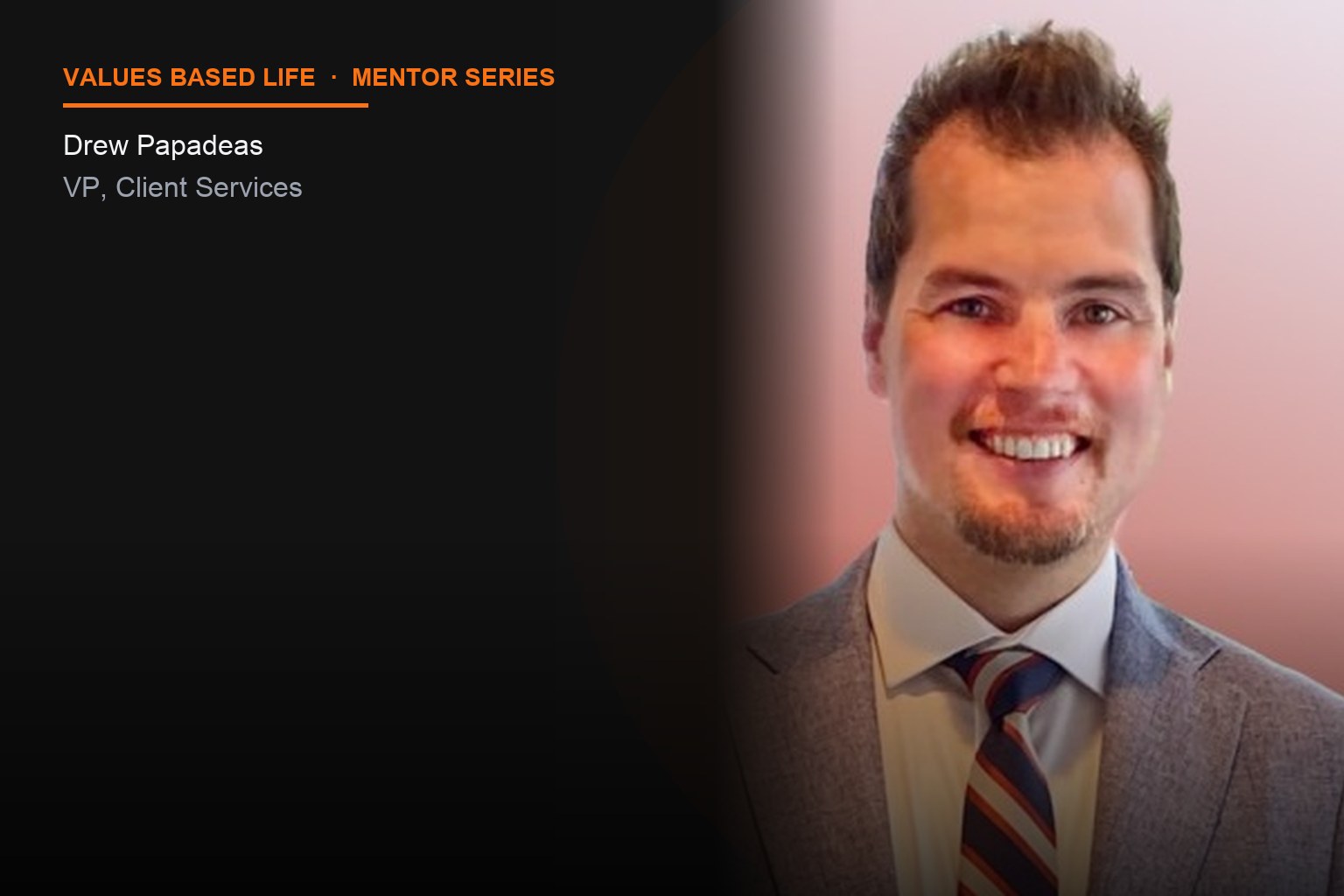
A Values-Based Technology Studio: Values Based Life Podcast
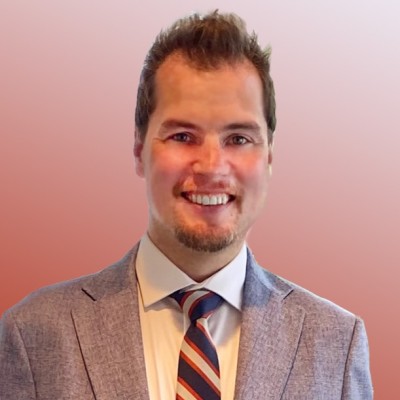
VP, Client Services
Drew Papadeas, VP of Client Services at Dom & Tom, joined Robert MacPhee on the Values Based Life Mentor Series to talk about what it actually looks like to run a technology studio in alignment with its values. The episode is not a product tour. It is a working description of how the company partners, how it grew, and how it is absorbing AI without losing the plot.
Listen to the full conversation: Mentor Series: Drew Papadeas on Apple Podcasts.
A studio, not a finished painting
Drew has been at Dom & Tom for 16 of the company's 17 years. He describes the work in plain terms: custom software, mobile apps, web applications, design, and strategy, for startup founders and for teams inside larger organizations. The positioning is collaborator and expert in the room, not vendor who delivers an artifact and leaves.
His analogy for the difference: it is not art class. You do not paint a picture, hang it on the wall, and look at it for the rest of your days. Technology work stays fluid. Startups, mid-market companies, and enterprises all need the thing to keep moving after launch.
That is also why the company now calls itself a technology studio rather than only a digital product agency. Product is still the work. It is no longer the whole job.
Music, Queens, and being multi-faceted
Drew's path was not a straight line. He has two degrees in music composition, including a 2004 master's in orchestral writing and scoring plus electronic music technology. He used to build software instruments. In the late 2000s he took that builder's mindset into freelance web development for small and mid-size businesses, when every company needed a site.
He met Dom and Tom Tancredi because they lived across the street in Queens. They asked him to build a few websites. After those freelance projects he quit his job and joined in 2010 as the first in-house hire. They wanted a full-time developer. He knew enough to be useful and was more interested in client work: building, collaborating, and, in his phrase, orchestrating impact.
He still treats the music training as operating system, not biography. Short, medium, and long-term plans. How a piece unfolds. Sales cycles, development cycles, launch cycles, release plans, and the rhythm of a market. Complex moving parts aimed at a common goal. That is the job, whether the score is an orchestra or an eight-workstream client.
Do Good. Be Good. was there on day one
MacPhee asked whether the culture showed up later, once the company had grown. Drew said no. Family, trust, integrity, honesty, passion, and enjoying the work were present immediately. Dom and Tom were scouts as kids. Do Good. Be Good. is the motto because it was already the behavior.
He also quoted a house rule that belongs to Dom: strong opinions, held weakly. Have a point of view. Leave room for other experts. Align on a North Star. The safe space is not softness. It is what makes the work better.
Growth that made the culture louder
Dom & Tom was a six-time Inc. 5000 fastest-growing company across 2014 through 2019. The studio expanded from New York and Chicago into Los Angeles, grew to about 125 full-time people, and ran a contractor bench numbered in the hundreds. It is still independent. It still lives and dies by client results and word of mouth.
MacPhee asked the obvious question: did that kind of growth make the family culture harder to keep. Drew said the opposite. Team gatherings, award ceremonies, lunch and learns, holiday parties. The camaraderie amplified. Culture was the through-line that made difficult executive decisions possible, including the ones that affected people downstream.
The footprint changed. The company is no longer in three cities. Since COVID it has been distributed, with coworking in New York and Chicago. Most of the people doing the work are senior. Mentor and intern programs exist. The series work is staffed with small, expert teams sitting close to the client, now with AI-native workflows underneath to keep quality up and cost down.
Long-term contractors are treated as part of that room. They are in the weekly meetings. Specialists hired for a one-off, a Bluetooth hardware engineer for a single feature, get less of a cultural onboarding, and Drew put the culture-fit weight in recruiting at roughly a quarter to a third depending on involvement. The test is the same either way: get in, help, raise your hand when you do not know something.
Business, users, and technology
MacPhee heard something larger than shipping sites and apps. Drew agreed, and then made it concrete. Technology is a means to results. The studio does not build a thing for the sake of the thing. Every engagement has to hit a goal, financial or social.
The frame is a triad, used at the roadmap level and at the button level.
Business. What is the metric. A 10 percent lift in sales. A 20 percent gain in team efficiency. Align there first.
Users. If the request is a new app, an AI feature, or a chatbot on the site, unpack what that actually means. Better customer experience. A more capable support team. Self-service lead generation, and if so, to what end. Design the experience the way a product like ChatGPT was designed: spacing, fonts, what happens on click, how you manage more than one thread.
Technology. Is it feasible. What is the level of effort. Is it scalable. Is it worth it.
Then drop to the micro. Why is that button there. What does it do for the business. Does the user know it is there, and what happens after the click. What does it take to build. If those three do not line up, you do not have a plan. You have a hobby.
He pointed to Kevin Allen's The Hidden Agenda for the sales version of the same idea: people and companies decide on the emotional driver underneath the statement of work. Parking cars is the activity. First and last impression for a restaurant's guests is the job. Building technology is the activity. The client's outcome is the job.
From product to process
AI came up twice, as capability and as culture. Last year, Drew said, companies still did not know where to put the investment. This year agentic systems can do work on your behalf while you sleep: lead lists, software, internal automations. That is the shift that turned a digital product agency into a technology studio.
The new question is not only "what product should we build." It is which manual processes inside the business should become automated, and how product work changes operations once it ships. Unpacking operations with current clients surfaces the useful question: why are we doing it this way, and wouldn't it be better if. The studio now builds process as well as product, because AI has made those layers more interconnected than they used to be.
Inside the team, the mood is not fear of replacement. Designers, strategists, engineers, and infrastructure people want the tools. The constraint is time. Updates arrive weekly. The hard part is taking your head above water long enough to operationalize what is working: standardize models, know what happens in each stage of the lifecycle, measure it. Experimenting is easy. Making it the way the studio works, while client deadlines are still real, is slower. Drew was clear that evolving with AI has to be done with intent, not by accident.
He was equally clear about the companies Dom & Tom mostly serves: established mid-market organizations, often 150 to 1,000 people, 20 to 50 years old, with a C-suite in the mix. They are not starting from zero. They have to move brick by brick. If they do not, his view is that they are unlikely to be around by 2029. The studio's job is to get the companies that exist today to where they need to be, without pretending they can become a native AI startup overnight.
Slowly but surely
MacPhee's closing ask was for other leaders who want the culture side, not just the output. Drew's answer was to keep the mission in view. The reason you are in business usually has nothing to do with technology. Technology is how you deliver that reason. The noise is the risk. Task forces sent out to catalogue every new AI tool are how you lose the North Star.
That is the role he sees for a partner like Dom & Tom: ground leaders long enough to keep going where they said they were going, with better methods, on a process you can implement over time. Tech is moving fast. His mantra is not. Slowly but surely wins the race.
Listen to the episode: Mentor Series: Drew Papadeas on Apple Podcasts. Follow Drew on LinkedIn, or start with the weekly newsletter from domandtom.com.
Book a call. We will tell you whether a sprint, a retained team, or a process engagement is the right next step.
About the author
VP, Client Services
Drew Papadeas leads client services at Dom & Tom. He works with product and business leaders to scope, staff, and ship digital products, and writes on product discovery, delivery, and agency partnerships.
Frequently asked questions
What is the Values Based Life Mentor Series?
Values Based Life is a podcast hosted by Robert MacPhee. The Mentor Series interviews executives at organizations that operate in alignment with their mission, vision, purpose, and values, and that have built cultures people want to work in. Drew Papadeas, VP of Client Services at Dom & Tom, appeared on the series in May 2026.
How has Dom & Tom kept its culture through growth?
Drew traces Do Good. Be Good. to day one, along with family, trust, integrity, honesty, passion, and having fun. The studio grew through six Inc. 5000 appearances, an LA expansion, and a peak of about 125 full-time people plus a large contractor bench. He said the culture did not dilute. It got louder, and it is what made hard executive decisions possible.
How does Drew Papadeas describe what Dom & Tom does?
Dom & Tom is a New York and Chicago technology studio that designs, strategizes, and builds custom software, mobile apps, and web applications. Drew describes the work as fluid partnership, not a finished painting you hang on a wall: the studio collaborates with startups, mid-market companies, and enterprises to push initiatives forward.
What does balancing business, users, and technology mean?
Every recommendation has to serve a business goal, a user-centered experience, and a feasible technical path, at both the roadmap level and the button level. Technology is a means to results. If no one uses the thing, or it does not move a metric, it is a hobby.
How should established companies adopt AI without losing the plot?
Drew's advice is to keep the mission in view and treat technology as the delivery system, not the destination. Established mid-market companies should shift brick by brick, operationalize AI with intent you can measure, and avoid standing up a task force to chase every new tool. His line: slowly but surely wins the race.
Ready to build something amazing?
Let's discuss your project and explore how we can help bring your vision to life.